These calculators provide preliminary estimates for qualified professionals only. They are not a substitute for analysis by a licensed engineer, some use region-specific assumptions, and you are responsible for verifying every result before use. Terms of Use
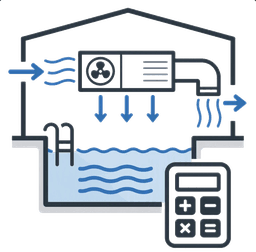
Pool Ventilation Calculator
Supply air flow for an indoor swimming pool hall
Method:
Units:
Sizes airflow by the code air-change minimum (10 ACH).
m²
200.0 m²2,153 ft²
m
Volume 700.0 m³
code min: 10
code min: 30%
%
code min: 25%
% of 10× flow
Extracted low, near the water surface, where chlorine by-products accumulate.
Results
Room volume
Air volume
700.0 m³
200.0 m² × 3.5 m
Air-change minimum
Volume × 10 ACH
7,000 m³/h
4,120 CFM · 1,944 l/s
Total supply air flow
Set by air-change minimum
7,000 m³/h
4,120 CFM · 1,944 l/s
Supply split
Fresh air (30%)
2,100 m³/h
1,236 CFM · 583 l/s
Recirculated (70%)
4,900 m³/h
2,884 CFM · 1,361 l/s
Exhaust (balances fresh air)
Total exhaust
2,100 m³/h
Equals the fresh-air intake · 1,236 CFM · 583 l/s
Chlorine exhaust — lower zone (25% of 10×)
1,750 m³/h
1,030 CFM · 486 l/s
General exhaust
350 m³/h
206 CFM · 97 l/s
Required climate conditions in the pool hall
- • Pool hall temperature: 24–27 °C (75–81 °F)
- • Relative humidity: 40–60%
- • Ventilation: 10 air changes per hour, with at least 30% fresh air
- • Extract air from the lower zone of the hall and supply air from the upper zone
VixeldorfDetailed mode estimates evaporation with the ASHRAE natatorium equation (E = Fₐ·(0.089 + 0.0782·v)·A·(p_w − p_a) ⁄ h_fg) and sizes airflow from a moisture mass balance (Q = evaporation ⁄ Δx). Air keeps ~1–2 K above water to limit evaporation. Results are estimates — verify against manufacturer dehumidification data and local code before final design.
Reviews & comments
No comments yet — be the first to share your experience.